8.24.2012

mitchell


Many years have elapsed since I last updated this blog. Begun while lonely in London, wandering the streets of Paddington with a heavy iPod IV in tow - I thought my head would explode.  The results of my musings lay entombed on this site, like a miniature time capsule.

Leaving London and my blog behind, I returned to Cleveland in the late summer of 2007. I spent my nights doling out Ballantines to the good people of Tremont, having secured a bartending gig at Prosperity Social Club.  It was there, on a muggy September evening just after my shift, that I met two fresh-faced boys sitting at the bar.  One of them, sporting a white blazer, ratty bicycle gloves, and thread-bare jeans, was particularly engaging.  We discussed topics as far ranging as the merits of Saussure's structuralist linguistics to the new Formula One regulations, when what I assumed to be his girlfriend marched up and announced, "I'm leaving." The pretty girl dramatically stormed out of the bar, slamming the screen door in her wake.  Red-faced, he hurriedly shook my hand and mumbled, "I'm Mitch, by the way." I watched, bemused, as he quickly collected his pool cue, and shot out the door.

I knew that night that I had met someone special - someone singularly exceptional. In the hazy, dingy, and ultimately superficial world of Cleveland bar culture, Mitchell shined - a man apart, a gentleman.  With a razor-sharp wit and erudite knowledge of, well, everything under the sun, Mitch was truly a polymath - a polymath in cut-off jean shorts. In the five years since I last updated this blog, I would come to count him as one of my closest friends and confidantes.  On Sunday, July 29th, 2012, he was killed.

I told myself I would not write on the subject for at least a month (several aborted obits and weepy elegies thankfully never saw the light of day), such a pause seemed necessary to allow the tremendous weight of the situation to dissipate, albeit slightly.  And now I sit, nearing the one-month anniversary of my friend's death, unwilling or perhaps unable to accept the kind of closure implicit in this task.

Bridget Callahan, one of Mitch's many acquaintances and a seasoned blogger, wrote an eloquent and frankly touching memorial shortly after his death - it is the kind of piece I wish I had written myself, the true measure of its worth.  She weaves through an impressively accurate list, "Mitch was this, Mitch was that," and he was, indeed, all she describes, but much, much more.  And now he is nothing.

Left in such a vacuum, I cling to Mitchell's words - lost in the reverie of what amounts to a technological archive of our friendship. Death in the age of information, what a curious phenomenon - texts, emails, facebook messages, and a trove of jpg's - fragile, and ultimately intangible remnants of a life lost.   So little hard copy - I scroll through years-old text messages, the very last, sent less than 24 hours before his untimely death, reading "i do feel a compelling urge to get outta here...and see you..."

At an exhibition on the life of Percy Bysshe Shelley at the New York Public Library in June, as I lingered over the meticulously preserved relics of his life I remember feeling a pang of jealousy - woe for our modern disconnectedness.  Here was laid a panoply of Shelley-related objects, from his baby rattle to a section of his skull, lovingly collected, palpable reminders of the now incorporeal.

I recall pausing at the very last letter sent by Shelley's friend, John Keats, to the poet before his death.  Rife with tuberculosis, he explained to Shelley: "I am pick'd up and sorted to a pip.  My Imagination is a Monastry and I am its Monk... I am in expectation of Prometheus every day. In the hope of soon seeing you I remain most sincerely yours..."  But Keats never saw Shelley again - the letter left hanging like an unanswered text.  Keats's death that spring inspired Shelley's masterpieceAdonaïs: An Elegy on the Death of John Keats (1821), to my mind, one of the more beautiful expositions on the loss of a friend:

"...he is not dead, he doth not sleep,
He hath awaken'd from the dream of life;
'Tis we, who lost in stormy visions, keep
With phantoms an unprofitable strife,
And in mad trance, strike with our spirit's knife
Invulnerable nothings. We decay
Like corpses in a charnel; fear and grief
Convulse us and consume us day by day,
And cold hopes swarm like worms within our living clay."
(Stanza 39, Lines 343-351)


Shelley recognized what I now know: that death is actually for the living.  Left with the absence, we wander about aimlessly, keeping with phantoms, looking to fill the void.
 
Each day since July 29th I have been tagging along with Shelley, rotting, striking out at invulnerable nothings, on a losing search for comfort. This situation is all the more vexing given my background.  One of my research interests is post-mortem photography, more generally the Victorian perception of death, and their materials of mourning.  I have spent the better part of my graduate career trying to uncover their lost rituals, examining mementoes of death such as hair jewelry (making jewelry from the hair of the deceased was extremely popular in America, well into the twentieth century).  I once organized a small exhibition of memorial hair jewelry for the Cincinnati Art Museum, and got the chance to handle hundreds of these small, poignant relics.  Holding a tiny ring in my palm containing plated brown hair from the early nineteenth century, I felt it was strangely charged with emotion, nigh hundreds of years after the hair was clipped - remains of what was?


A Ring Containing Keats's Hair, Bodleian Library, University of Oxford


Mitchell was killed by a drunk driver, struck down while standing at a street festival behind a barricade.  His death was extremely violent and traumatic, therefore, I was shocked to see the casket open at his memorial.  Wearing his trademark white blazer, sunglasses folded neatly on his lapel, his strange body laid awkwardly, hands like claws covered in heavy make-up.  But his hair, oh his hair - spilling down onto his shoulders, faintly moving in the draught of air from a nearby door, a cruel mirage of life. I felt an uncontrollable urge to discreetly snip a lock of his blonde tresses, to make a talisman for my grief - but I could not move.  Humbled in the presence of death, I searched his frozen face for a glimmer, a mere glint of what once was - and found, once again, nothing.  

In a collection of pensées, the French writer François Mauriac ponders the paradoxical nature of this confrontation:

"For a corpse is essentially an absence, an abandoned, rejected thing -- mortal remains at last. A feeling of trickery enters into the hideous dismay which we experience at the spectacle of death: our loved one is there and is no longer there. He has escaped from himself and in his flight he leaves this part of his being, the only visible and tangible part, which nevertheless no longer resembles him." -- Cain, Where Is Your Brother? (1962)

As I said farewell to the shell of my friend for the last time, I noticed a stain forming on the arm of his white sleeve - something was leaking out of that thing that was no longer Mitch.  A grim moment, but ultimately helpful - I took a deep breath, and stilled my heaving chest.
As I stood there over his casket, watching the circle of embalming fluid grow, I finally acceded that indeed, there was nothing there.  Nothing.

I slowly weaved my way out of the bland chain-store funeral parlor room, packed wall-to-wall with so many heartbroken people, and remembered what Mitchell said to me back in May. In what I try not to think of as a horrendous bit of foreshadowing, I was hit by a van myself crossing the street in Brooklyn. Miraculously I escaped injury, but was rather shaken. "I don't know if I could deal with losing Brittany," said Mitch in a text message dated May 30th.  Yes, you could, Mitch. Because somehow, we must.


2.01.2007

flâneur


Emile Deroy, Charles Baudelaire, 1844, oil on canvas, Musee de Versailles


Anyone living in a big city, consisently using mass transit, or simply walking down a busy street understands the feeling of seeing someone for a flash - a spectacular moment of connection - only to see it vanish forever in a few steps. It's a peculiar phenomena of city-life - these ephemeral love affairs, ending as quickly as they begin...a thousand tiny little deaths every day.

In Paris in the 1850s, Charles Baudelaire, gentleman stroller of the city streets par excellence, experienced the very same feeling. His poem, À une passante (To A Passer-By), is one of a series of poems called the Tableaux Parisiens, in the 1861 edition of his Fleurs du mal (Flowers of Evil):


To A Passer-By

Amid the deafening traffic of the town,
Tall, slender, in deep mourning, with majesty,
A woman passed, raising, with dignity
In her poised hand, the flounces of her gown;

Graceful, noble, with a statue's form.
And I drank, trembling as a madman thrills,
From her eyes, ashen sky where brooded storm,
The softness that fascinates, the pleasure that kills.

A flash...then night! O lovely fugitive,
I am suddenly reborn in your swift glance;
Shall I never see you till eternity?

Somewhere, far off! too late! never, perchance!
Neither knows where the other goes or lives;
We might have loved, and you knew this might be!


In a previous entry I was musing on the Victorian fascination with physiognomy and it's correlation with the onset of city life in the age of Industrialization -- and there clearly is a connection here. The crowd can be menacing, filled with criminals and deviants, but it also allows for a new kind of romance....the fleeting, spectral, modern kind.

11.29.2006

lament

Thomas Hardy, ca.1915


A friend told me recently about the Japanese custom of writing 'jisei' - or 'death poems' - a practice that stretches back to ancient times, when, at the moment of death, one's life is summed up in a few, usually simple lines. Here is a fairly recent example:

Like dew drops
on a lotus leaf
I vanish.
---------Senryu, died June 2, 1827

I was stunned today to learn that while on his death-bed, Thomas Hardy dictated a "death poem" to his wife. Hardy, perhaps best known as the author of a string of famous novels, such as Jude the Obscure, Tess of the d'Ubervilles, Far From the Madding Crowd and The Return of the Native, was an impressive poet as well...(and was often encouraged by his mentor and friend, George Meredith).

Falling suddenly ill with a terminal resperatory disease in December of 1927, Hardy was dead within a month. Yet in that month, faced with his demise, he took the time to compose a final verse. In what would be his final lines on this earth, the fading poet seems to realize that the secrets of death are better left unsaid.


HE RESOLVES TO SAY NO MORE (1928)

O my soul, keep the rest unknown!
It is too like a sound of moan
When the charnel-eyed* Pale Horse has nighed:
Yea, none shall gather what I hide!

Why load men's minds with more to bear
That bear already ails to spare?
From now always till my last day
What I discern I will not say.

Let Time roll backward if it will;
(Magicians who drive the midnight quill
With brains aglow can see it so,)
What I have learnt no man shall know.

And if my vision range beyond
The blinkered sight of souls in bond,
-- By truth made free
-- I'll let all be,
And show to no man what I see.


*charnel = a building or chamber in which bodies or bones are deposited

11.22.2006

crush

I've been meaning to 'pen' a George Meredith appreciation post. He has been mentioned in passing in earlier posts, but I've never fully explained his 'story', or touched on why he is my favourite writer. [Disclaimer: What follows is entirely unacademic, filled with gossip, and is based on a romantic attachment to a dead person.]

George Meredith is all but forgotten today. A quick google search brings up a few flimsy biographies, and poor Meredith lacks the true gauge of popularity in our modern, digital world: a fake myspace page created in his honor. Not much of a buzz for the man Oscar Wilde once cited as his favourite novelist, saying: "Ah, Meredith! Who can define him? His style is chaos illuminated by flashes of lightning."

Perhaps you have never heard of Meredith the writer, or read one of his novels, but you may have actually gazed at his face without knowing it. Meredith, as a favour, modeled for the painter Henry Wallis, in his most famous painting, The Death of Chatterton, an event that changed the course of his life.


Henry Wallis, The Death of Chatterton, 1856
oil on canvas, Tate Gallery

Meredith sat several times for the artist, who, for accuracy's sake, wanted to use an actual poet for his depiction of Chatterton. Best known as the Romantic Movement's poster boy, Chatterton committed suicide by swallowing arsenic after repeated failures at getting his poetry published, rather than face starvation at the tender age of 17.


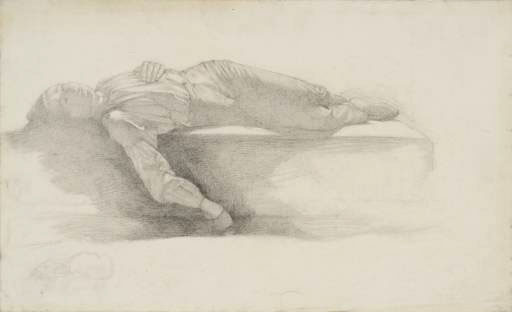
Henry Wallis, Study for The Death of Chatterton, 1856
pencil on paper, Tate Gallery

Despite the long hours, George Meredith was more than happy to sit for his friend; and even brought his wife, Mary Ellen Meredith, along. She was older, from an affluent, artistic family, and had plenty of time to chat with Wallis as her husband lay stretched out pretending to be dead. In an irony of epic Romantic proportions, Mary Ellen left Meredith for the dashing painter.

Her agonizing departure from his life was far from swift. It was in fact slow, complicated, tortuous even, as most break-ups are wont to be. In an age when divorce was nearly unheard of, the transference of her affections to the artist took time. This horrifying period of Meredith's life inspired what is perhaps his greatest work, a series of sonnets called Modern Love, written in 1862. If you're feeling especially energetic, you can read the poem in its entirety (all 50 sonnets!) here; but I think the first sonnet is enough to recognize Meredith's amazing ability at capturing the death of a love, using some of the most beautiful phrases I've ever read...


I.

By this he knew she wept with waking eyes:
That, at his hand's light quiver by her head,
The strange low sobs that shook their common bed
Were called into her with a sharp surprise,
And strangled mute, like little gaping snakes,
Dreadfully venomous to him. She lay
Stone-still, and the long darkness flowed away
With muffled pulses. Then, as midnight makes
Her giant heart of Memory and Tears
Drink the pale drug of silence, and so beat
Sleep's heavy measure, they from head to feet
Were moveless, looking through their dead black years,
By vain regret scrawled over the blank wall.
Like sculptured effigies they might be seen
Upon their marriage-tomb, the sword between;
Each wishing for the sword that severs all.


11.09.2006

likeness


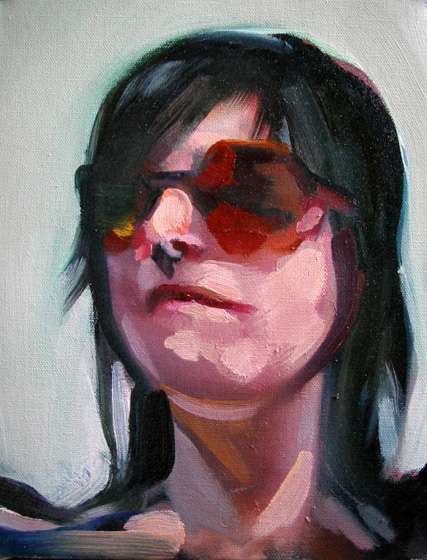
Cecelia Phillips, Brittany, 2006, oil on canvas

This entry is long overdue. But I think I've detected a pattern of late in my life - a trend if you will.

It is only natural as a human being to elicit some sort of interest in portraiture. But for the past year or so I've put what some may describe as an alarming amount of time and energy into 1) convincing others to create my portrait, and 2) to the study of the portraiture of others.

1) In an ongoing artistic project/performance, I am trying to have every artist that I know make some form of portrait/likeness of me - creating a catalogue of "selves" - or interpretations of myself mediated through others, so to speak. I've only just started, but already have acquired some top-notch portraits. The problem with such a project is that you're basically asking an artist to make and give you an original work - an obligation that is not always welcome.

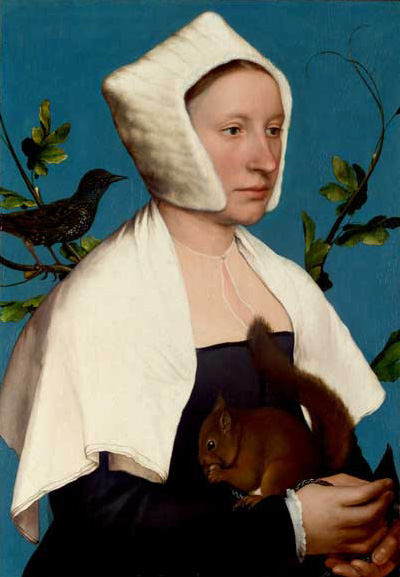
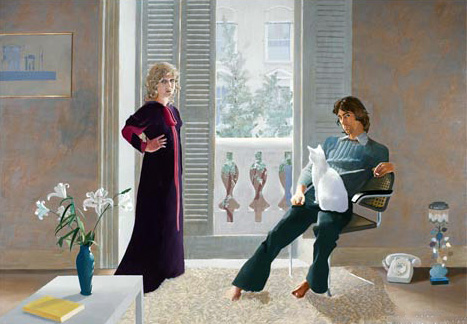
2) In the past two weeks I have seen two amazing exhibitions of portraits by two of my favourite aritsts: Hans Holbein and David Hockney - two artists separated by the gulf of centuries, but interestingly both painting portraits mainly of english people:


Hans Holbein the Younger
A Lady with a Squirrel and a Starling,
about 1526-8, oil on oak


David Hockney
Mr. and Mrs. Clark and Percy,
1970-71, acrylic on canvas

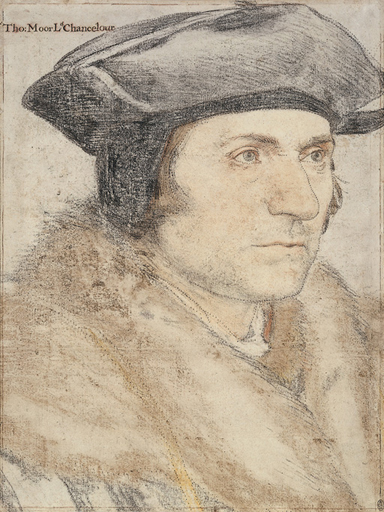
And while these are two very beautiful examples of their finished work, I find that the drawings included in both of these exhibitions are truly the show-stoppers. Hasty sketches on paper, capturing moments, glances: Hockney's drawings of Celia Birtwell and a young Gregory Evans are particularly riveting ---Likewise, Holbein's sweeping gestures in chalk capturing the faces of the English nobility in a single sitting are - quite literally - mesmerizing, judging by the amount of time I stood examining the delicate whiskers and finely wrought wrinkles around the eyes of Sir Thomas More.....


Hans Holbein the Younger
Sir Thomas More
1526-27, black and coloured chalks on paper


I suppose I should draw some sort of earth-shattering conclusion -- connecting all my thoughts on portraits together - but I'm afraid that I cannot. It all comes back to the face. This strange fixation I have with faces and identity. (Please go back to my earlier post on physiognomy for clarification). I guess I'm interested in how people can perform as active agents in their own visual construction - through the hands of others.

"Put your best face forward."


10.25.2006

primitives

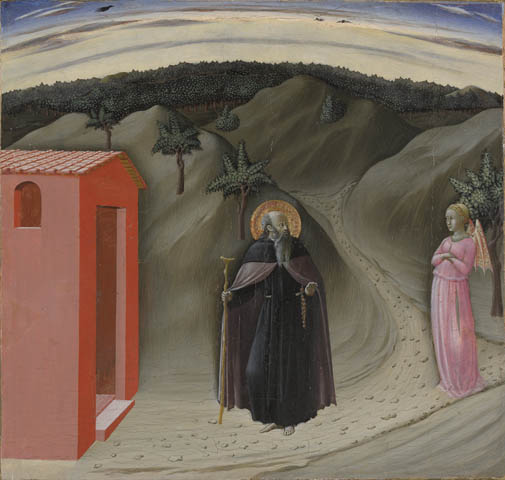
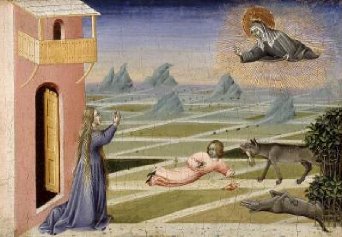
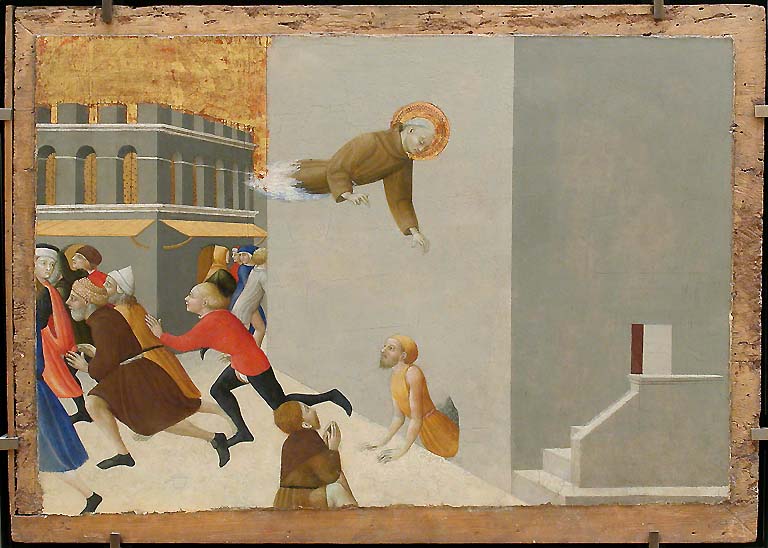
Another frequent activity of mine is spending time in the Sainsbury Wing of the National Gallery with the early Italian paintings. It's free, and a few of my all-time-favorite paintings are on view. I think the guards may think I am a bit odd. People generally walk through these rooms briskly, on their way to the famous Van Eycks nearby. I'm the only person that sits on the bench admiring these undervalued gems:


Sassetta, The Wolf of Gubbio, 1437-44
This is one panel of an altarpiece depicting scenes of the life of St. Francis; who you see here shaking hands with a wolf who had been terrorizing the inhabitants of Gubbio. To the right you can just make out the parts of a dismembered body he's maimed, and in the background the path in the woods is strewn with limbs. One of the best details is the women peeking through the spaces in the city wall. I realize it's impossible to see here. You really need to be in front of the painting to appreciate it.


Giovanni di Paolo
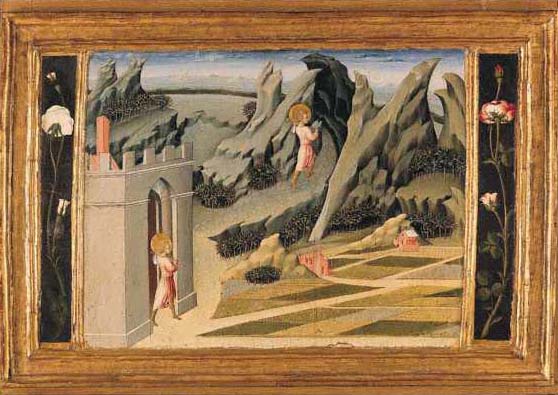
Saint John the Baptist Retiring to the Desert, probably about 1454
I think it's the way these Sienese artists treated landscapes that interests me most. That, and the palette. The soft pastels these artists used were probably not purely an aesthetic decision - I'm not sure that egg tempera allowed for much variety. And the flatness, the use of shape, and form - this is before the rules of perspective and the Renaissance ruined everything.

Other favorites, not in London, but on my make-believe wish-list:


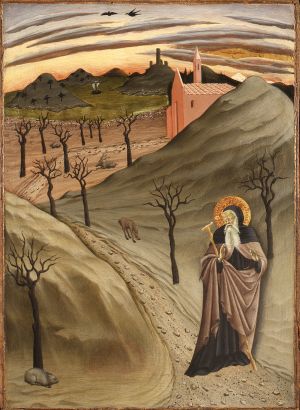
Maybe by Sassetta, but more likely the Osservanza Master
Saint Anthony the Abbot Tempted by a Heap of Gold, ca. 1435
Lehman Collection, the Met, NYC


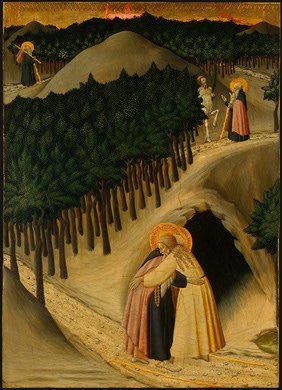
Master of the Osservanza
The Meeting of Saint Anthony and Saint Paul, ca. 1430/1435
National Gallery, Washington DC


Master of the Osservanza
Temptation of Saint Anthony Abbot, ca. 1435
Yale University Art Gallery, New Haven, Connecticut


Giovanni di Paolo
Saint Clare Saving a Child from a Wolf, ca. 1455—60
Museum of Fine Arts Houston


Giovannii di Paolo
Ecce Agnus Dei (Behold the Lamb of God), 1455-60
Art Institute of Chicago


Sassetta
Ranieri saves the poor from a prison in Florence, ca. 1437-1444
The Louvre, Paris
(thank yous to john ennis for starting it all with this painting)

Alright I could post like twenty more...


10.19.2006

physiognomy

The Victorians were obsessed with physiognomy. And now I'm obsessed with their obsession.


phys·i·og·no·my
Pronunciation: "fi-zE-'ä(g)-n&-mE"
Function: noun
1 : the art of discovering temperament and character from outward appearance
2 : the facial features held to show qualities of mind or character by their configuration or expression

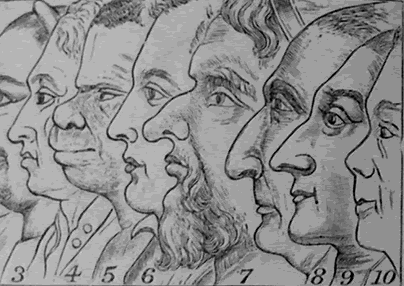
Like other (fairly quack) scientific pursuits such as phrenology, physiognomy reflects the Victorians' fondness for categorizing, organizing, and classifying - not just flora and fauna, geological strata, but people as well. Determining a person's character or temperament by the curve of their nose, or shape of their eyes, seems oblique and basically racist in today's day and age - but I'm starting to understand why there was such an appeal. Well I have a theory anyway.

In 1851, the census returns showed that for the first time in the history of England, the population in the cities outnumbered those in the rest of the country at large. In the swirling leviathon that was Victorian London - population was out of control. And the most shocking thing is that this massive shift of density happened in only a matter of decades. A society that had been basically rural and agrarian had become concentrated in one giant pile of soot, mud, and rubbish blanketed in fog.

Imagine living in a small city or village in the 1830's. When you walk down the street, you know the people you pass, or at least you recognize them, can place them - who they are, who their people are, their occupation, their connection to you on the small cultural map that is existence.

Now imagine Victorian London circa 1850. The streets packed, choked with people - people of all different classes, backgrounds, and occupation - winding their way through the hectic metropolis, suddenly shoved together into common quarters. Street vendors hawking, costermongers shouting, street sweepers doing cartwheels, horses pounding by, things being pushed upon you, about you and all over you. Imagine this, all covered with a sooty fog of black smoke so dense that you can barely determine the weather. Strangers are all around you, literally brushing up against you. Your cultural map is now populated with hundreds upon hundreds of vacant glances, shady leers, and suspicious intentions.

This is a drastic difference, and obviously a generalisation. But thrust into this new situation, the Victorians** tended to look at the surface of things to figure them out - quickly. "Placing" or "determining" a person was a decision that had to be made on the spot, and they truly believed that one could easily accomplish this simply by reading the quality of a person's facial characteristics.

The writings on the subject are utterly fascinating and a bit hilarious. Here's a great example from "The Physiognomist's Own Book: an introduction to physiognomy drawn from the writings of Lavater, 1841":

"CUNNING, DECEIT, AVARICE.
In such a face we may search in vain, for a single expression of frankness; for the slightly projecting chin, when accompanied with small penetrating eyes, denotes the absence of sincerity. There is no display of benevolence in the oblique mouth ; and avarice reveals itself in the close-locked lips. Combine all these features, and they result in a cunning, deceitful, avaricious, and not merely firm, but stubborn old fellow. Such a man moves quick, and speaks slowly and circumspectly; for suspicion is the mainspring of his character."

Of course illustrations accompany the descriptions - so you can find out if your gardener falls under the category of "Frankness, Intrepidity, Good Nature" or "Egotism, Suspicion, Treachery, Avarice, Corroding Care" based on his profile.


**I realize using the blanket term "Victorians" is hugely problematic, as basically only upper and middle class males had access to the ideas of physiognomy via books, journals, etc. But I do think that the idea of "reading a person's countenance" for personality traits had somehow filtered down to most of society...